
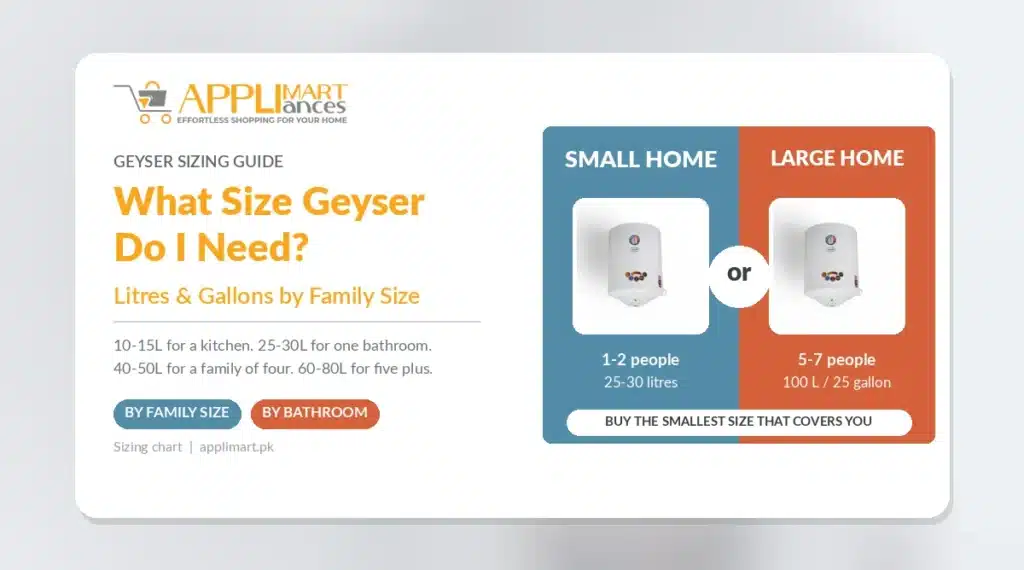
The short answer: 10–15 liters for a kitchen sink, 25–30 liters for one bathroom, 40–50 liters for a family of four, 60–80 liters for five or more people, and 35 gallons or larger once you have three bathrooms running in the same hour. Buy for your normal week, not your worst-case day — an oversized tank costs you electricity every day of the year.
That is the quick version. The rest of this guide explains how to check it against your own home, how gallons translate into liters, and why recovery rate matters more than tank size once your household passes four people.
Geyser Size Chart by Family Size
| Your household | Bathrooms | Size to buy | Models that fit |
|---|---|---|---|
| Kitchen or basin only | — | 10–15 L | Canon 10 LCF, Canon 15 LCF |
| 1–2 people | 1 | 25–30 L | Canon 25 LCF, Fischer F-30 Heavy, NasGas NEG-30 |
| 3–4 people | 1 | 40–50 L | Fischer F-40 Heavy, NasGas NEG-50, Eco Watt 50 L Heavy |
| 4–6 people | 1–2 | 60–80 L | Fischer F-60 Heavy, Fischer F-80 Heavy, NasGas NEG-80 |
| 5–7 people | 2 | 100 L or 25 gal | Fischer F-100 Heavy, NasGas DEG-25 |
| 6–8 people | 2–3 | 140 L or 35 gal | Fischer F-140 Heavy, Fischer Gas 35 Gallon |
| 8+ people, or a guest house | 3+ | 220 L or 55–100 gal | Fischer F-200 Heavy, Fischer Gas 55 Gallon, Fischer Hybrid 100 Gallon |
Browse the whole range by size: 10 to 80 liter fast electric geysers for wall-mounted units, or 25 to 100 gallon storage geysers for floor-standing tanks.
Gallons or liters? Converting Between the Two
Pakistani geysers are sold in both units and it confuses almost everyone. Electric wall-mounted models are rated in liters; gas and hybrid storage tanks are rated in gallons. The conversion is:
| Gallons | Approx. liters | Roughly equivalent to |
|---|---|---|
| 25 gallon | ~95 L | A 100 L electric tank |
| 35 gallon | ~130 L | A 140 L electric tank |
| 55 gallon | ~210 L | A 220 L electric tank |
| 65 gallon | ~245 L | Larger than any electric model we stock |
| 100 gallon | ~380 L | Commercial scale |
You can verify this against our own spec sheets: the NasGas DEG-35 is sold as a 35 gallon unit and its specification lists 130 liters, and the Canon GWH-35 Supreme Twin Auto is likewise a 35 with a 130 liter tank.
The practical takeaway: a 25 gallon gas geyser holds roughly the same water as a 100 liter electric one. If you have been comparing a 55 gallon gas unit against an 80 liter electric one, you have not been comparing like with like — the gas tank holds nearly three times as much.
Why Recovery Rate Matters More Than Tank Size
Tank size tells you how much hot water you have at the start. Recovery rate tells you how fast it comes back. For a household of one or two, tank size is all that matters. Past four people showering in sequence, recovery rate decides whether the last person gets a cold one.
Most brands do not publish it. NasGas does, on every NEG model:
| Model | Tank | Recovery rate | Element |
|---|---|---|---|
| NEG-30 | 30 L | 8 gallons/hour | Imported steel |
| NEG-40 | 40 L | 10 gallons/hour | 2000W |
| NEG-50 | 50 L | 12 gallons/hour | 2000W |
| NEG-60 | 60 L | 15 gallons/hour | 3000W |
| NEG-80 | 80 L | 20 gallons/hour | 3000W |
Note the NEG-60 and NEG-80 jump to a 3000W element. That is where the recovery gain comes from. If your household showers back to back in the morning, a smaller tank with a 3000W element will often serve you better than a larger tank with a 2000W one — and it will cost less to keep warm the rest of the day.
The same logic applies to the largest Fischer models: the F-140 uses twin 1500W elements and the F-200 twin 2000W elements, because a 220 liter tank on a single element would take most of the morning to recover.
What Oversizing Actually Costs You
A geyser spends most of its life doing nothing except keeping water hot. That standing loss is proportional to how much water you are keeping hot — so a 100 liter tank serving a two-person household is paying to reheat roughly 60 liters nobody will ever use, every single day, all winter.
Three signs you have oversized:
- Your geyser is still hot late at night when nobody has used it since morning
- You never run out of hot water even when the whole family showers
- Your winter electricity bill jumps far more than your usage pattern changed
If you genuinely need a large tank, look for models that let you manage the draw. The Eco Watt 60 Liter Heavy lets you switch the element between 800, 1200 and 2000 watts, which is useful on weak wiring and for gentle overnight heating.
Sizing for Instant Geysers
An instant geyser has no tank, so none of the above applies. It heats water as it flows and is rated in kilowatts rather than liters. The Daichi RP-55 runs at 2.1–5.5 kW and works from as little as 0.02 MPa of water pressure.
Size an instant unit by how many taps run at once, not by household size. One tap at a time is fine. A shower and a kitchen sink together is not. That makes instant the right answer for a kitchen or a second washroom, and the wrong answer as a whole-home solution.
Frequently Asked Questions
What size geyser do I need for a family of 4?
A 40 to 50 liter electric geyser for a single-bathroom home, or 60 to 80 liters if you have two bathrooms or shower back to back in the mornings. If you use a gas or hybrid tank instead, a 25 gallon model holds roughly the equivalent of 95 liters.
How many liters is a 35 gallon geyser?
About 130 liters. Our NasGas DEG-35 and Canon GWH-35 are both sold as 35 gallon units and both list 130 liter tanks on their specifications. A 25 gallon is roughly 95 liters and a 55 gallon roughly 210 liters.
Is a bigger geyser always better?
No. A geyser keeps its whole tank hot whether you use the water or not, so an oversized tank raises your bill every day of the year. Buy the smallest size that covers your normal usage, and prioritise recovery rate if several people shower in sequence.
What is recovery rate on a geyser?
It is how much hot water the geyser can produce per hour once the tank starts running low, usually quoted in gallons per hour. The NasGas NEG range runs from 8 gallons per hour on the NEG-30 to 20 on the NEG-80. Above four people, it matters more than tank size.
What size geyser is best for one bathroom?
25 to 30 liters for one or two people, 40 to 50 liters for three or four. If the bathroom has a bathtub rather than only a shower, size up one step — filling a tub uses far more hot water than a shower does.
Still Not Sure?
Tell us three things — how many people live in the house, how many bathrooms are used in the same hour, and whether your gas holds pressure in January — and we will tell you the smallest geyser that will actually do the job. Browse the full geyser range to compare sizes and live prices side by side.